


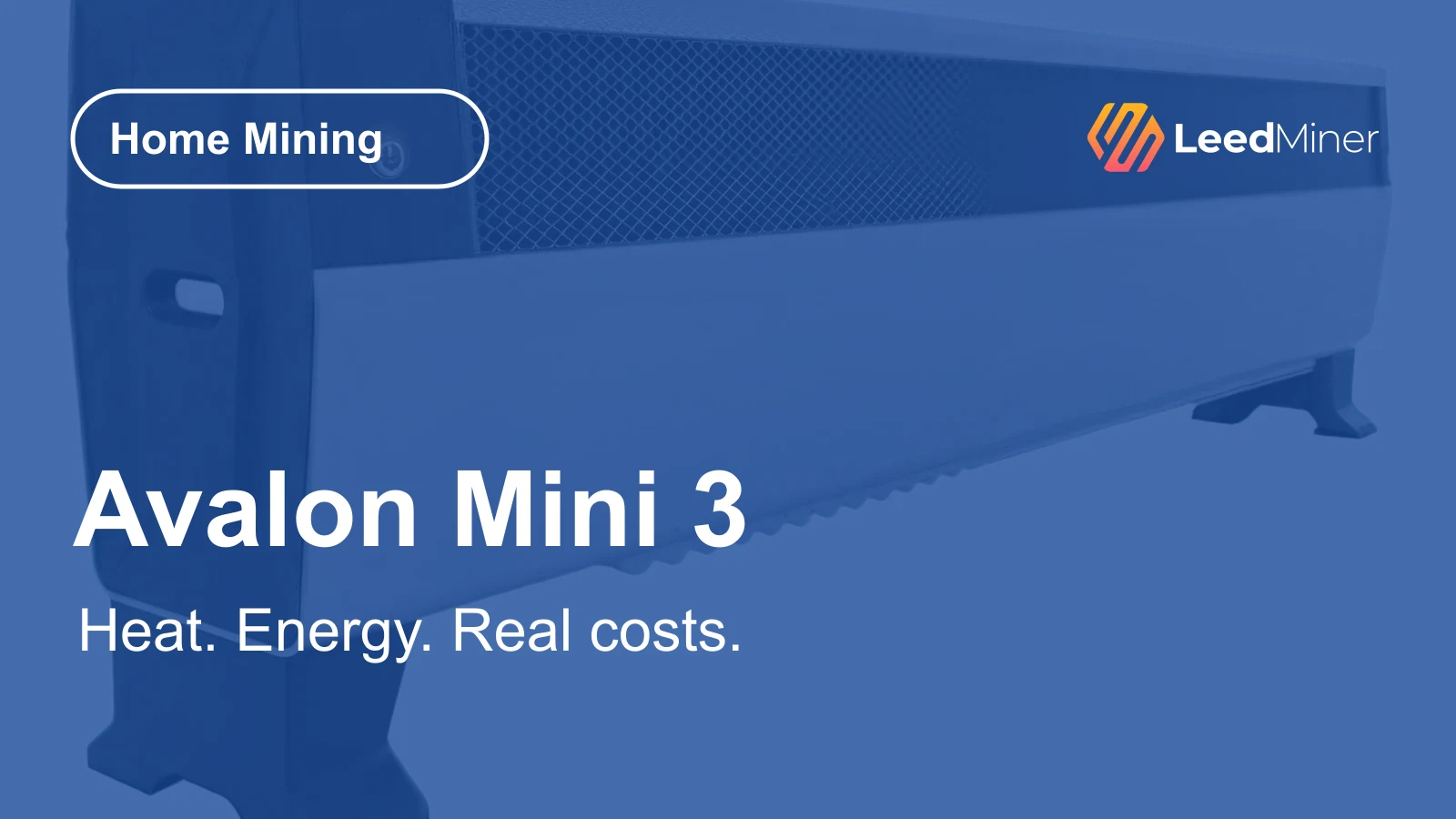
Is the Avalon Mini 3 a useful home heater?
The Avalon Mini 3 combines Bitcoin mining with space heating, but useful heat is not the same as free heat. Consider it when you want to learn about mining and have a room that genuinely needs additional warmth. Evaluate electricity use, comfort and mining receipts separately before deciding whether it fits your home.
Canaan lists a headline hashrate of 37.5 TH/s and 800 W heating output for the Mini 3. These are manufacturer figures, not measurements from a LeedMiner test. They are not a promise of continuous output in every mode. See Canaan’s home-miner announcement.
For current configuration and availability, check the Avalon Mini 3 product page. This guide focuses on running costs and heating decisions rather than a hardware sale price or a fixed daily return.
Choose the mode for the room
Canaan’s mode documentation distinguishes the following options:
| Mode | Manufacturer description |
|---|---|
| Heater Eco / Super | 500 W / 800 W settings; room-temperature control can pause operation. |
| Mining | Prioritizes mining; no room-temperature target and potentially more fan noise. |
| Night | Prioritizes quieter heating with adjustable room-temperature control. |
Use the current manual and app for operation. Avoid treating a mode name as a guarantee of silence or a measured hashrate. Record room conditions and actual consumption when comparing settings; thermostat pauses change both heat delivery and mining time.
Calculate electricity before estimating earnings
The basic calculation is energy in kWh = average power in kW × operating hours. Then multiply energy by the applicable electricity tariff. Use measured average power, including idle periods, for a real household budget.
The examples below assume an uninterrupted 800 W load and an illustrative tariff of US$0.15/kWh. They are arithmetic scenarios, not measured Mini 3 consumption, local electricity quotes or mining forecasts.
| Assumed running time | Energy at 0.8 kW | Electricity cost at US$0.15/kWh |
|---|---|---|
| 6 hours | 4.8 kWh | US$0.72 |
| 12 hours | 9.6 kWh | US$1.44 |
| 24 hours | 19.2 kWh | US$2.88 |
With time-of-use pricing, calculate each tariff period separately. Add relevant charges and any cooling or ventilation costs. A heater that cycles off should not be budgeted as though it runs at full power all day, and its mining output should not be projected that way either.
Use the mining profitability calculator with current inputs and your tariff. Confirm the model, hashrate, power and data timestamp rather than treating a saved result as a forecast. A lower electricity bill than another scenario is not automatically a positive investment return.
Heat reuse is not a guaranteed saving
Decide what heating the Mini 3 would actually replace. If it warms a room that was previously unheated, it adds a new cost instead of avoiding an existing bill. If heat is unwanted, its heating credit is zero; cooling it away can add another expense.
A heat pump is a different comparison from an electric resistance heater. Heat pumps move heat and can supply more heat energy than the electricity they consume, as explained by ENERGY STAR. Do not credit a miner with an entire heat-pump bill or assume equal electricity consumption for the same room temperature.
For your own worksheet, separate three items:
- Mining cash margin: actual mining receipts minus electricity, pool charges not already deducted and operating costs.
- Avoided heating cost: only the cost of heating demonstrably displaced over the same period.
- Ownership cost: hardware, delivery, installation, maintenance and other applicable expenses.
Keep heating savings outside the mining-only result so they are not counted twice. Compare a full season, including mild days, rather than multiplying one good winter day by a year. Bitcoin price, network conditions, pool terms and downtime can change receipts. A fixed daily-profit figure without dated assumptions is not a dependable budget.
What to check before buying
Confirm the exact unit’s voltage, plug and installation requirements against its manual and rating label. Have a qualified electrician assess the circuit where needed; a home-miner label is not a substitute for an electrical suitability check. Keep placement, clearances and operating conditions within the manufacturer’s instructions.
Ask for noise evidence that identifies the mode, distance and room conditions. This article does not claim a LeedMiner sound test or a guaranteed heating area. Insulation, outdoor temperature and heat loss differ between homes. Also confirm delivery terms, warranty coverage and the current setup instructions rather than assuming an old pool pairing or app workflow still applies.
If the requirements fit, contact LeedMiner with your country, intended room, electricity tariff and operating schedule. Request configuration confirmation before deciding; no particular mining return or heating saving is promised.